Modular Switch Buying Guide: Ranges, Price Bands and What Actually Matters
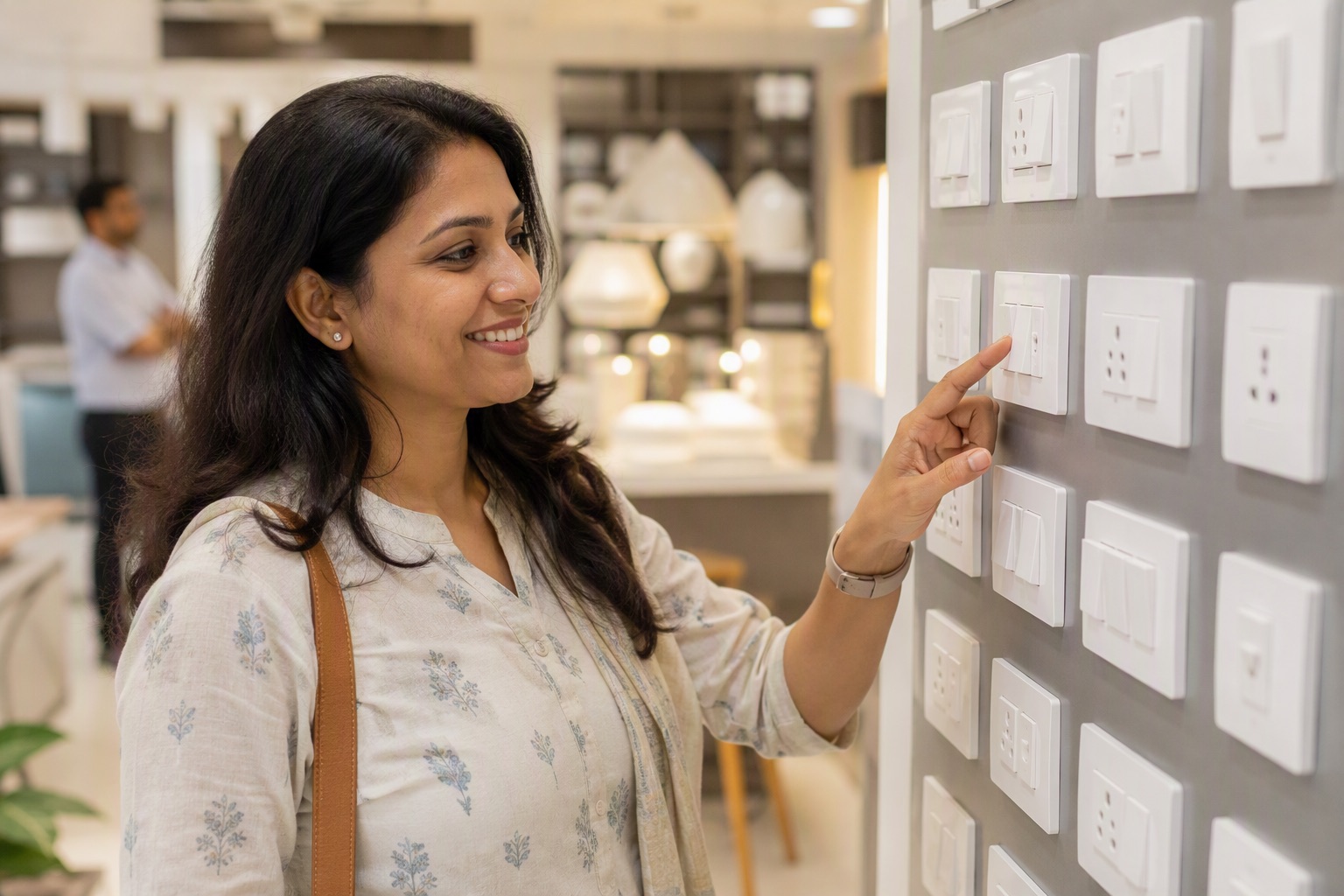
Modular switches are the only electrical product in the house your family will touch every day and the only one guests will notice. They are also where the electrical budget swings most — the same house can take ₹35,000 or ₹1,60,000 of switches depending on the series.
How the ranges are structured
Almost every brand sells three or four tiers built on the same modular frame, so plates and modules are interchangeable within a brand:
| Tier | Approx per point | What you get |
|---|---|---|
| Entry | ₹180 – ₹350 | Basic polycarbonate plates, standard rockers, limited colours |
| Mid | ₹350 – ₹700 | Better plate finish, softer switch action, wider module range |
| Premium | ₹700 – ₹1,500 | Metal or glass-finish plates, silent or feather-touch action, matching accessories |
| Designer / touch | ₹1,500 – ₹4,000+ | Glass, touch panels, dimmers, automation-ready |
"Per point" here includes the module, its share of the plate and the mounting box. A 3BHK with 120 points is therefore roughly ₹45,000 at entry level and ₹1,20,000 at premium.
What actually differs between tiers
- Contact material and rating. The metal inside the switch decides how many thousand operations it survives. This is the real difference, and it is invisible.
- Switch action. Premium ranges use a different mechanism that stays consistent for years rather than becoming loose and rattly.
- Plate material. Polycarbonate yellows slowly in sunlight; better polymers and metal finishes do not.
- Module availability. Higher ranges have fan regulators, dimmers, USB sockets, bell push, TV and data modules that match visually.
- Colour consistency across batches — relevant if you extend the wiring two years later.
How many points does a house really need?
| Room | Sensible point count |
|---|---|
| Living room | 2 light, 1 fan, 4–6 sockets, 1 TV point |
| Master bedroom | 2 light, 1 fan, 4 sockets, 1 AC point |
| Other bedrooms | 1–2 light, 1 fan, 3 sockets, 1 AC point |
| Kitchen | 2 light, 5–7 sockets (16A for major appliances) |
| Bathroom | 1 light, 1 exhaust, 1 geyser point |
| Balcony / utility | 1 light, 1–2 sockets, washing machine point |
That lands a 2BHK at roughly 60–90 points and a 3BHK at 100–150. Beyond this, extra points are usually contractor revenue rather than convenience — though a few well-placed extra sockets are the cheapest future-proofing you will ever buy, so spend them on the kitchen and beside the bed rather than on additional light points.
Socket types worth specifying
- 6A sockets for phones, lamps, chargers — the bulk of your points.
- 16A sockets for microwave, fridge, washing machine, AC. These need 2.5 or 4.0 sq mm wiring, so they must be planned before wiring, not chosen at the end.
- USB modules beside beds and in the living room. Genuinely useful; specify the amperage rather than assuming.
- Fan regulators — step-type is reliable and cheap; electronic is smoother and works better with BLDC fans.
Choose the brand before wiring, the colour at the end
Box sizes and module widths differ between brands, so the mounting boxes fitted during wiring commit you to a brand family. Decide the brand and series before the conduit and boxes go in; the plate colour and finish can be chosen months later, at painting stage. And buy switches last — they scratch, and three months on a dusty site does them no favours.
See our comparison of the best modular switch brands, which switch brand to buy, and approximate rates on the switches and sockets page.
Send your list on WhatsApp for an exact quote within 60 minutes. Approximate ranges on this page are for planning; WhatsApp 88676 76700 for today's firm rate, with no pressure to buy.
Frequently asked questions
How much do modular switches cost per point in India?
How many switch points does a 3BHK house need?
What is the real difference between cheap and expensive modular switches?
When should I choose the modular switch brand?
Should I buy 6A or 16A sockets?
When should modular switches be bought and installed?
Ready to order for your home?
Upload your wiring list for an instant quote — 100% original material, free next-day delivery across Bangalore.